©Vitor Oliveira from Torres Vedras, PORTUGAL (2019)
©Jose A. (2021)
Monumento aos Combatentes da Grande Guerra (Great War memorial)
Introduction
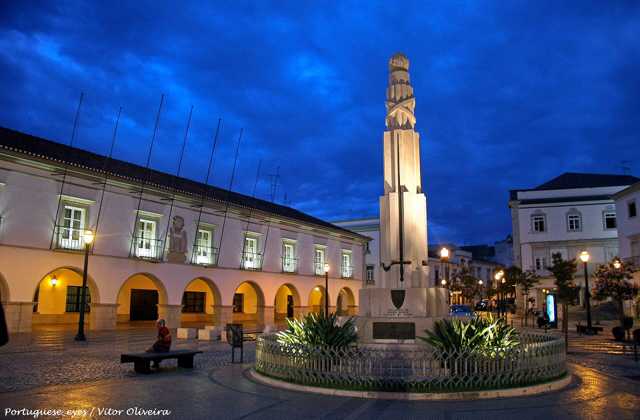
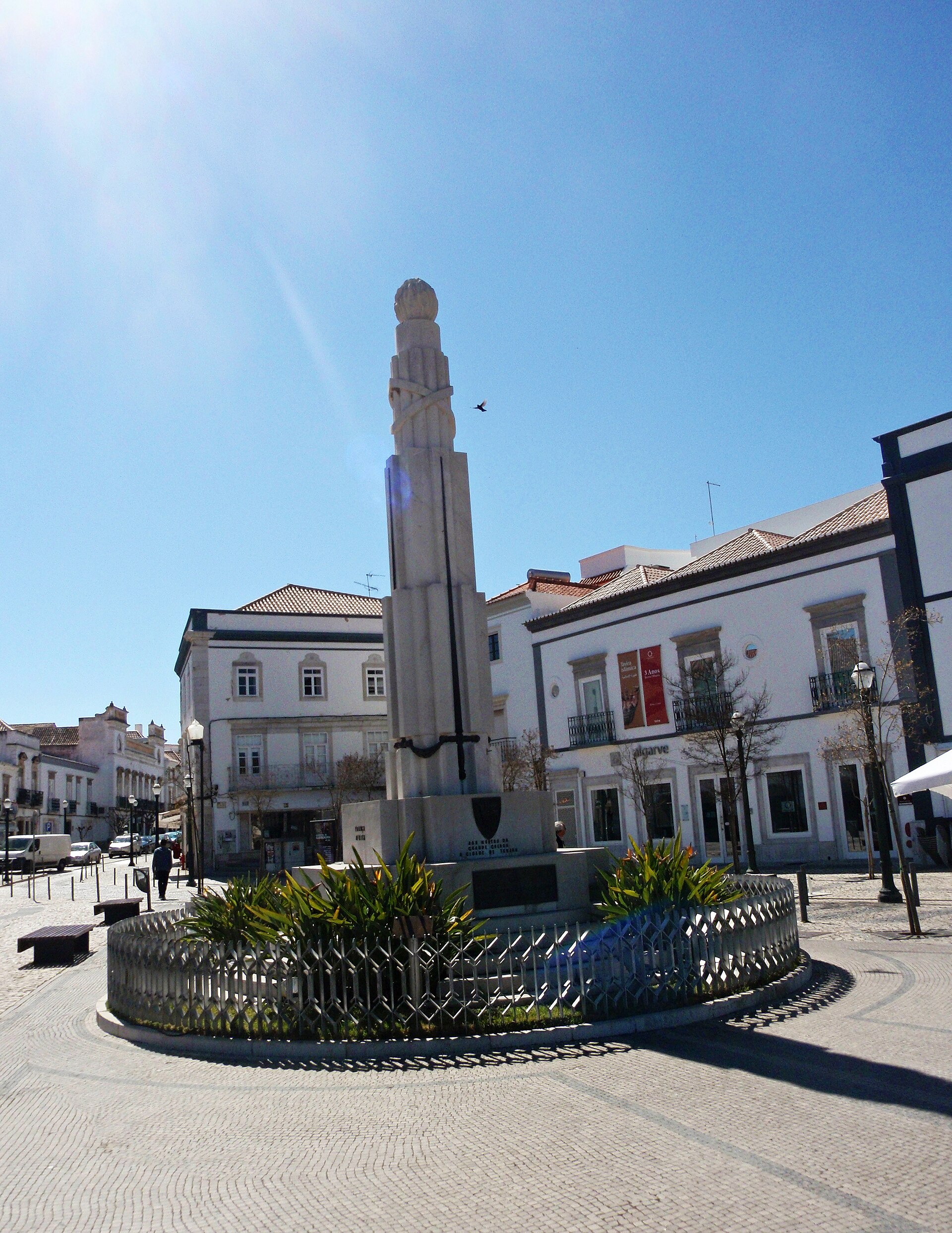
In the middle of Praça da República, in front of the town hall, stands a square limestone column with four bronze swords down its sides and a flame carved in stone at the top. It is Tavira's memorial to the fallen of the First World War, first and foremost the men of the 3rd Battalion of Regimento de Infantaria n.º 4, recruited in the Algarve, trained in Tavira and killed in Flanders. The town paid for it itself. The money came from three years of town festivals, President Carmona laid the foundation stone in February 1932, and the inauguration took place on 9 April 1933, the anniversary of the Battle of La Lys. No statue, no soldier. That was a choice, and it is still what makes the column worth stopping for.
Historical highlights
First a plaque in the barracks
At the Atalaia barracks the 3rd Battalion of Regimento de Infantaria n.º 4 was trained before it was sent to Flanders. 51 men did not come home, 48 fell in Flanders and 3 in Mozambique. Their names were carved on a memorial plaque in the entrance hall of the barracks, unveiled on 10 June 1920. But a plaque behind a barracks gate is not something the town can see. In the late 1920s the wish grew for a monument that honoured the dead "condignamente", as the town historian Anica writes.
Three years of festivals
The municipality did not have the money. So the town held festivals instead. The Festas da Cidade ran three summers in a row, 1930 to 1932, and the profit went to the monument; the municipality's Comissão Administrativa under João Parreira promised to cover the rest. The design went to the Tavira native Alberto Ponce de Castro, whom the sources variously call lieutenant, architect and engineer. Who else he was, nobody really knows.
The day with the president
On 16 February 1932 President Óscar Carmona came to Tavira, and the newspapers came with him. The town was decked with flags, there were rugs hanging in the windows, and flowers were thrown down on the party. The foundation document was sealed inside the stone together with a collection of the coins of the day, and Carmona did the mortaring himself. Afterwards he decorated the stonemason José Maria Bento, aged 70, and the sailor Francisco Laranjo, aged 75. Both wept, the newspaper wrote, while two seaplanes from Faro flew over the square.
Stone, bronze and no statue
War Minister Daniel Rodrigues de Sousa inaugurated the column on 9 April 1933. On a plinth of three steps stands a square limestone shaft which, at the top, turns into a bundle of cylinders, rifle barrels tied together by two bands, and uppermost a flame in stone. Four bronze swords stand upright in grooves on the sides, their hilts linked by bronze garlands of leaves and fruit. On the plinth Tavira's coat of arms and the national arms, and beneath it in bronze: AOS MORTOS DA GRANDE GUERRA A CIDADE DE TAVIRA. According to the art historian Laranjo it is one of only three monuments from the Salazar era in the Algarve without a statue or bust.
Practical
The column stands in the open on the square around the clock. Look for the plaque on the bottom step from 1968, the fiftieth anniversary of the armistice, and for the garlands between the sword hilts. In 1932 Ponce de Castro also designed the paving around the column: a sword in black stone in the light cobbles. Look down and see whether it is still there. Every 9 April the local branch of the Liga dos Combatentes holds a ceremony here, in recent years together with the Royal British Legion.
Timeline and context
Timeline
- 1910 The square is named Praça da República after having been called Ribeira and Constituição.
- 9 April 1918 The Battle of La Lys in Flanders.
- 10 June 1920 A memorial plaque with 51 names (48 from Flanders, 3 from Mozambique) is unveiled at the Atalaia barracks.
- 1923 The Tavira branch of the Liga dos Combatentes is founded, one of the association's first.
- 1926 Rua do Ribeirinho is renamed Rua dos Combatentes da Grande Guerra.
- 1930-32 The Festas da Cidade raise the money; the municipality under João Parreira guarantees the rest.
- 16 February 1932 President Carmona lays the foundation stone with a collection of coins inside.
- 1932 Ponce de Castro designs the paving around the column with a sword in black stone.
- 9 April 1933 War Minister Daniel Rodrigues de Sousa inaugurates the monument.
- 1968 The veterans place a plaque on the bottom step for the fiftieth anniversary of the armistice.
- 2007 Ricardo Agarez records the monument in the SIPA inventory.
- 2023 The local branch of the Liga dos Combatentes turns 100.
- 2024-25 The 9 April ceremony is held at the monument with the Royal British Legion.
Why in the middle of the square
For centuries Praça da República was the town's marketplace, a triangle with the town hall to the east and the bridge to the north. The column stands at the geometric centre of the square. The town wanted the dead out of the barracks and in where everyone passes by. The monument has no listing of its own; it lies within the protection zone of the Misericórdia church and is recorded in the SIPA inventory. It is the municipality's property, as the mayor promised in 1932.
A monument without a face
The column is of the padrão type, a memorial without a figure. Rifle barrels, swords, flame and two coats of arms, no soldier and no names; the names are in the barracks. It is still in use: the Liga dos Combatentes holds its La Lys ceremony here every 9 April, while the commemoration on 2 November takes place out at the cemetery's Talhão dos Combatentes. The town that partied the money together over three summers is the best part of the story, and it is true.