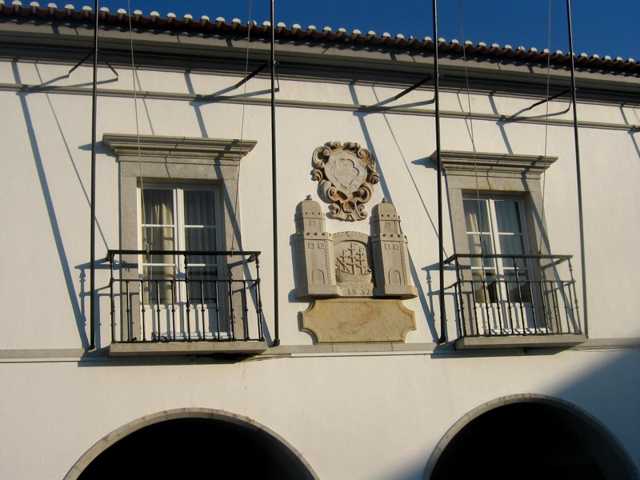
©John Edwards from Bristol, UK (2013)
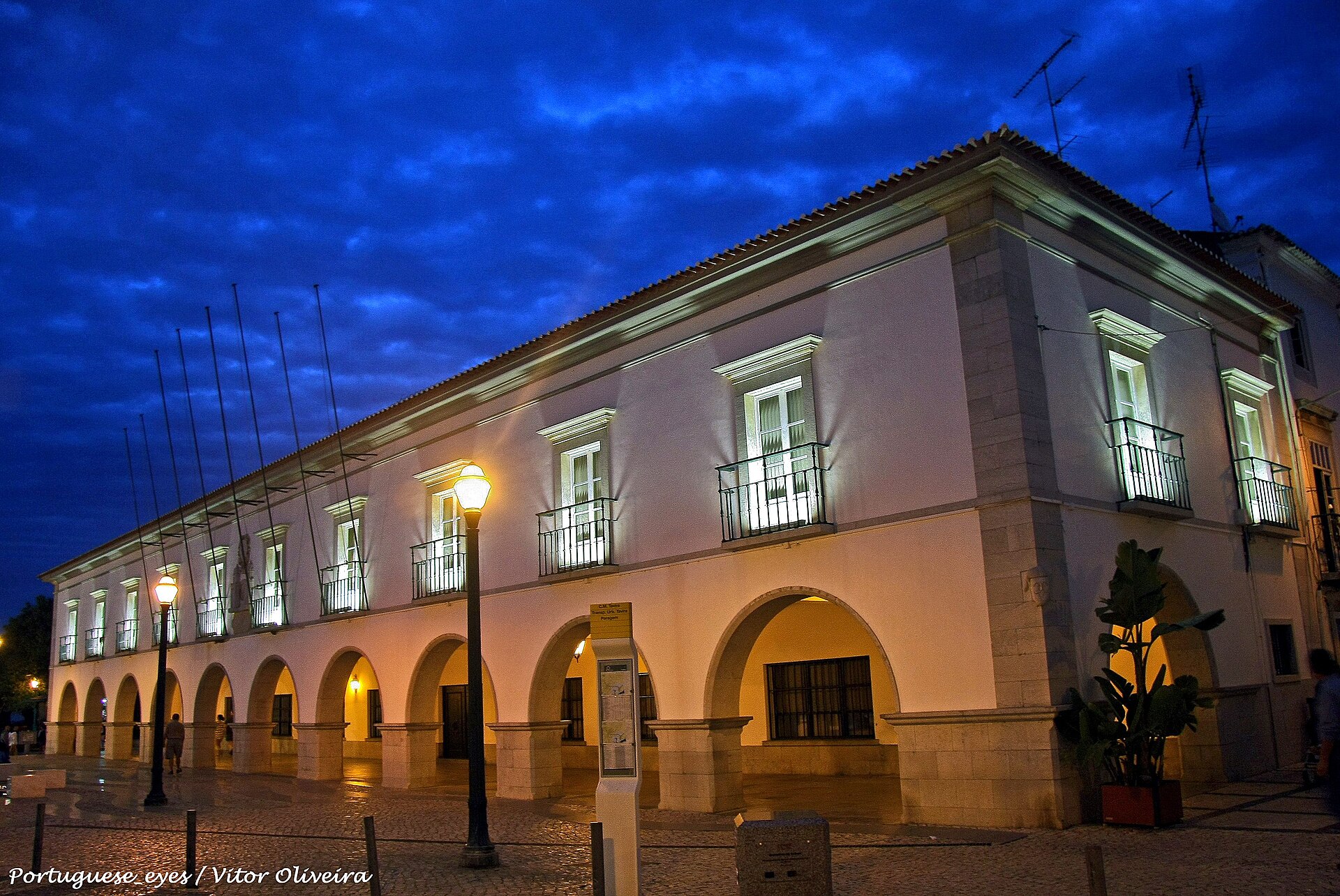
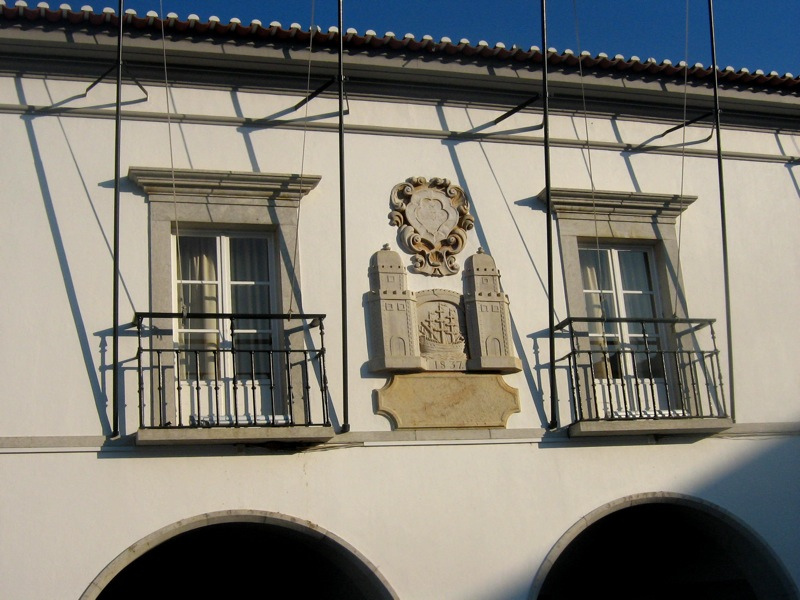
©Vitor Oliveira from Torres Vedras, PORTUGAL (2019)
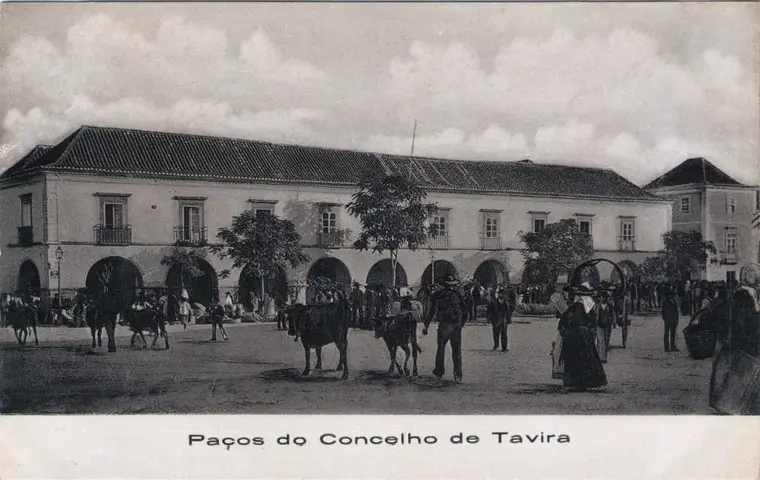
©Postal J. Vianna (Lisboa) «Paços do Concelho de Tavira», c. 1909 · Aveiro e Cultura – Arquivo Digital (1909)
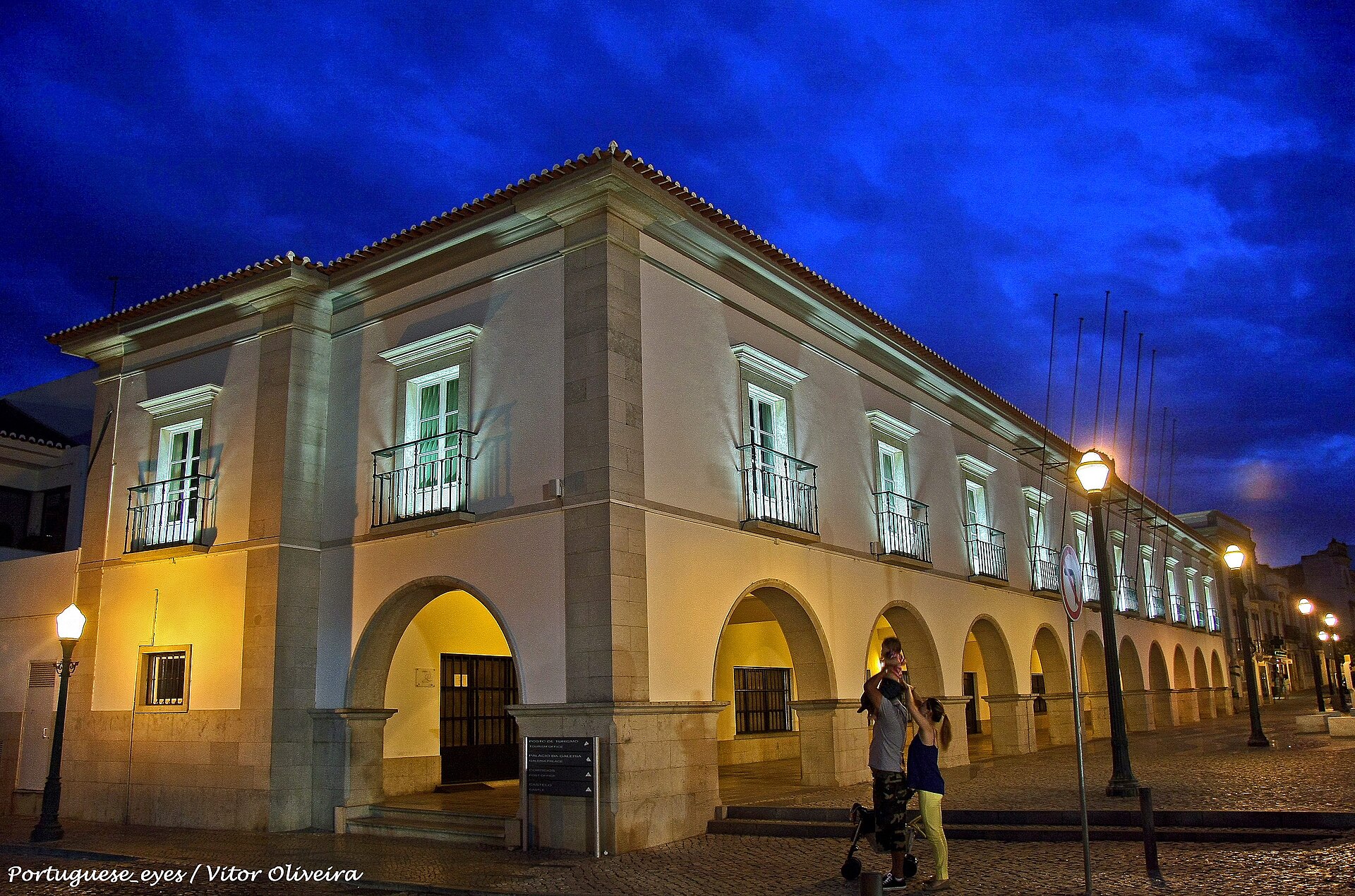
©Vitor Oliveira from Torres Vedras, PORTUGAL (2019)
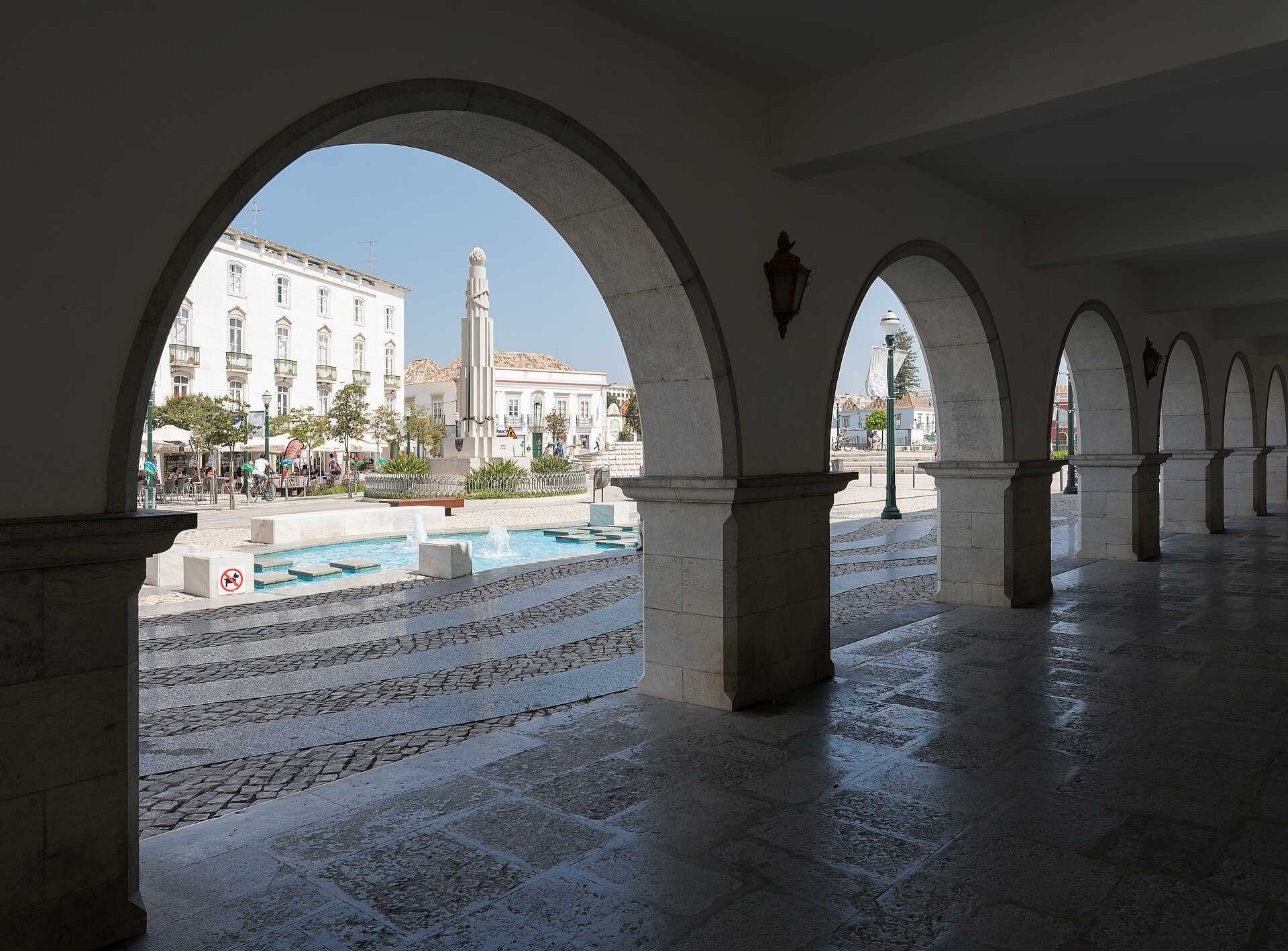
©Jules Verne Times Two (2024)
Paços do Concelho (Town Hall)
Introduction
The town hall on Praça da República looks old, with arcades on the ground floor and balconies above. It is not. The old house was demolished completely in 1954-55 and rebuilt as a copy of itself, and the arcades are cast in concrete. The town council has sat on this square since 1645, so the address is old enough; it is the building that is new. In the middle of the facade sits a stone with the municipality's old coat of arms, and on the south-west corner a carved stone head that the town calls D. Paio Peres Correia, the conqueror from the 1200s. The head is the only thing that survived the demolition. It is worth a close look, because the rest is the 1950s' idea of what the house looked like.
Historical highlights
A council on the move
Tavira received its first foral from Afonso III in 1266, and for the first centuries the council had no house. According to the municipal archive it met in the open on the forecourt of the Santa Maria church up in the castle. Around the 1520s it moved into a building at the top of what is now Rua da Liberdade, which later became the town's old prison. Only in 1645 did the council come down to the square by the river, and there it has been ever since.
The house that was torn down
The council moved into an arcaded house facing the square, where the ground floor and the main floor had been built at different times and did not match in their measurements. Fish was sold under the arches until the Mercado da Ribeira opened in 1887. In 1943 Café Arcada wanted to rebuild its frontage under the arcade, and the state architect from DGEMN called the house a "curiosa construção seiscentista" with a medieval arcade that "deve ser defendido de qualquer alteração". How old the arcade was, no source says.
The demolition of 1954-55
In December 1954 a citizen, Francisco da Silva, wrote to DGEMN asking them to save a "muito típico e antigo" house that was being pulled down in Tavira. The answer came in January 1955: the house was being rebuilt as a town hall, the project had never been submitted, the case was closed. In February the mayor confirmed that the town hall was being demolished in order to be rebuilt "na traça anterior", to the old design. And so it was. Arcades and balcony doors now line up exactly as they never did before, and the arches are concrete. The story of the copy is more interesting than the copy.
The head on the corner
On the south-west corner sits a carved stone head that the people of Tavira call D. Paio Peres Correia, who took the town from the Moors in 1239 or 1242. No source dates the head. Francisco da Silva thought already in 1954 that it could not possibly be the conqueror; to him it looked like D. João IV. But it is the only thing that came along from the old house. Passos wrote in 1995: "sobrou a cabeça do guerreiro". The stone in the middle of the facade bears the municipality's old coat of arms; the present one, with the bridge of seven arches, was fixed in 1932.
Practical
The house is a working town hall, so it is the facade you come for. Look for the head on the south-west corner and the stone with the coat of arms in the middle. In front stands the Monumento aos Combatentes da Grande Guerra, inaugurated in 1933. The arcades are used for the Feira da Dieta Mediterrânica in August, and the Museu Municipal occasionally gives guided tours inside under "Passeios na História".
Timeline and context
Timeline
- 1239 or 1242 D. Paio Peres Correia conquers Tavira.
- 1266 Afonso III grants the town its first foral; the council meets in the open by Santa Maria.
- c. 1520s The council moves to the house at the top of Rua da Liberdade, the later old prison.
- 1645 The council moves to the square by the river, where it still sits.
- 1755-1834 The governor of the Algarve sits in Tavira after the earthquake of 1755.
- 1822 and 1910 The square is renamed Praça da Constituição and later Praça da República.
- 1887 Mercado da Ribeira opens; the fish trade leaves the arcade.
- 1930 The old prison is demolished to make way for the post office.
- 1932-33 The Monumento aos Combatentes da Grande Guerra is raised in front of the town hall.
- 1943 DGEMN's architect demands that the house be protected from any alteration.
- 1954-55 The town hall is demolished completely and rebuilt as a copy; only the stone head is kept.
- 1961 Orlando Ribeiro describes the palace as half demolished by a restoration that left it as new.
Why the town hall is here
The council began up in the castle and ended down by the river, and that journey is the town's own. The square by the Gilão was the town's marketplace, with stalls every day and fish sold under the arcade until 1887, and power moved to where the trade was. It is still used that way: the Feira da Dieta Mediterrânica is held in the town hall's arcades.
A copy, and what to make of it
The building is not listed in its own right; it lies partly within the protection zone of the castle walls and in the critical area of the historic centre. That makes sense, because what you see is from 1954-55. The copy is neater than the original: the bays line up, and there are no longer two building periods to be seen. The price was losing a house that the state's own architect had called worth preserving twelve years earlier, and nobody today knows how old that arcade was. What remains from before is the head on the corner and perhaps the stone with the coat of arms. Honestly, that is not much, but it is a better story than the one about the unchanging town hall.
Then and now
Drag the divider to see the place as it was and as it is today. Both photos were taken from the same spot.
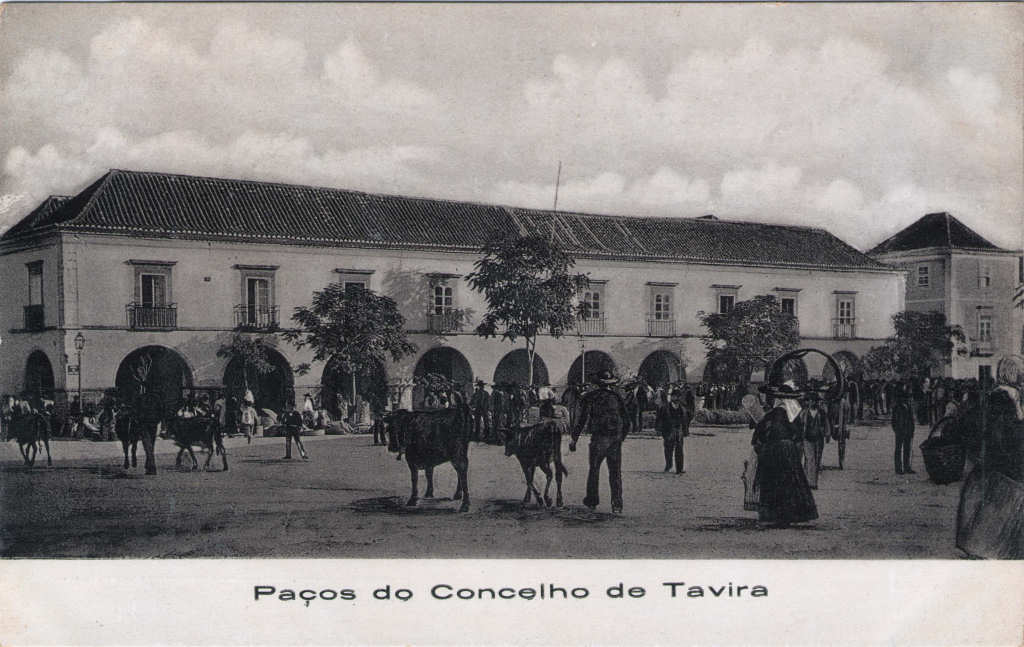 19092013
Temporary pair: the present-day photo has not yet been taken from the postcard's viewpoint.
Then: 1909 · Postal J. Vianna (Lisboa) «Paços do Concelho de Tavira», c. 1909 · Aveiro e Cultura – Arquivo Digital
Now: 2013 · John Edwards from Bristol, UK