Tavira
Estação Elevatória (Water pumping station)
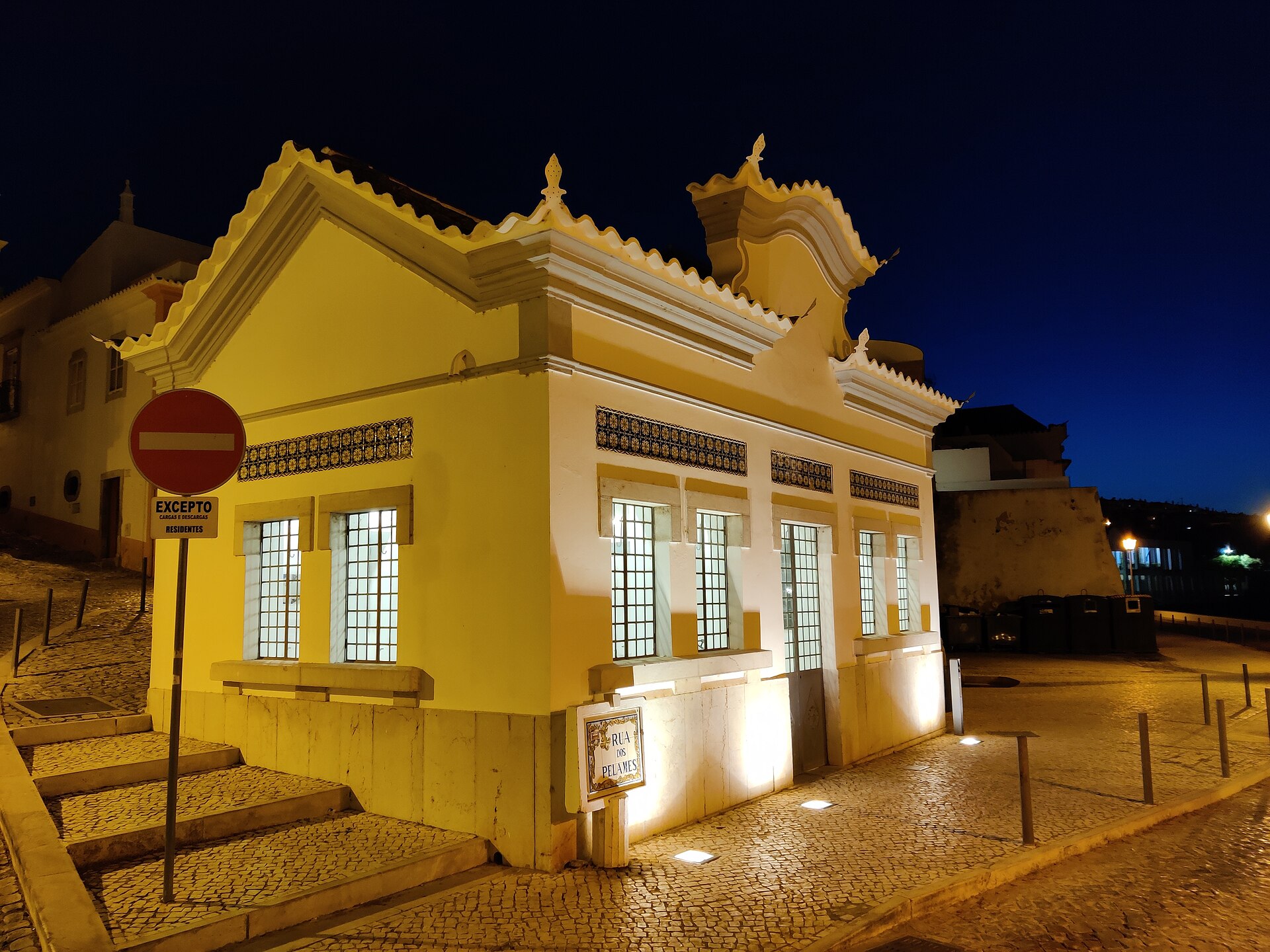
Pumping station from 1932 on top of the town's oldest spring, saved by a referendum in 1999.
Periods
Tags
Introduction
Beneath the small concrete building by Largo Gonçalo Velho lies Tavira's oldest public spring, Fonte da Praça, mentioned as early as the 13th century. In the early 1930s the town council built the pumping station on top of its source: two wells, two motor pumps and a reservoir, from which the water was forced up to the water tower on Alto de Santa Maria. The whole works was completed in 1932. In 1982 the building was to be demolished. It was not, and today it is a small museum about the town's water, with the two engines still standing in the machine hall. It is a more interesting story than the building suggests: water carriers, typhoid and a referendum.
Historical highlights
The spring beneath the house
Fonte da Praça draws on a water table that runs down the hill from Alto de Santa Maria past Palácio da Galeria. In 1726 the spring had warm water and four spouts, in 1841 five spouts and a bathhouse. The water went to drinking, grinding grain, tanning hides and to the ships in the harbour. The street name Rua dos Pelames recalls the tanneries that stood by the spring in 1774. The spring itself now lies between the pump house and the reservoir, and the wells are under the building.
The water carriers lose
Before the pipes there were aguadeiros, water carriers, who sold the spring's water around town. The council registered them in 1888 and 1892 and called them out under the fire brigade when something burned. In 1928 the engineer Manoel Alves da Costa was given the job. His project from December 1929 had four parts: the spring's source, a reservoir, a Casa das Bombas and the machinery. The pumps cost 29,400 escudos, the tank on the hill 90,612. In 1934 came the regulations, house owners were obliged to have pipes laid in, and the council accused the water carriers of "concorrência incompreensível e desleal" and put a tax on them.
Typhoid and river water
It did not go smoothly. In December 1935 there were complaints about the tap water, probably because river water was seeping into the wells, and in 1939 it was still poor. In 1942 the quality was good again, but the town had 11,000 inhabitants and was drawing up less water than it used. In 1947 there was typhoid in Tavira, several springs and wells were contaminated, and on 10 January the council closed them. Only then was fetching water by the bucket over.
Condemned to demolition
In 1982 the council's plan for the historic centre foresaw the pump house being removed, so that Calçada de D. Ana would have the river as its backdrop. That did not happen. In 1998 Tavira's network was connected to the Beliche and Odeleite dams, and in 1999 the council wanted to demolish the water tower on Alto de Santa Maria. In the referendum of 13 June 1999 the town voted to keep it. The tower became the Camera Obscura in 2004, and the pump house was converted into an interpretation centre in 2002; the museum itself dates the rehabilitation to 2009.
Practical
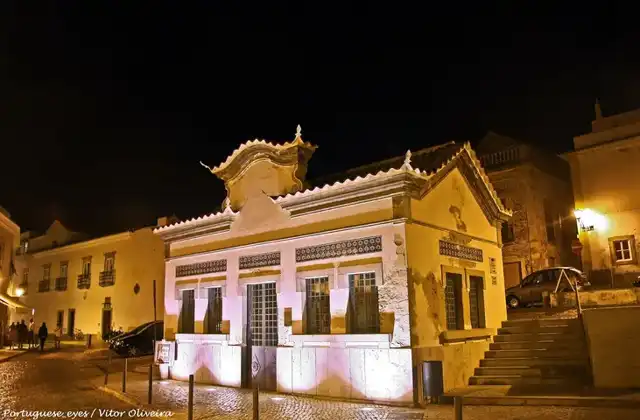
The centre belongs to Museu Municipal de Tavira; according to Rota da Dieta Mediterrânica it is open Tuesday to Saturday 9.30-13.00 and 14.00-16.30. Look for the azulejo panels above the door and windows, they are intact, and for the inscription "CÂMARA MUNICIPAL" on the east facade of the reservoir. Then walk up to the water tower by Igreja de Santa Maria, and you will have seen both ends of the system.
Timeline and context
Timeline
- 13th century Fonte da Praça is mentioned for the first time.
- 1726 The spring has warm water and four spouts; in 1841 five spouts and a bathhouse.
- 1774 Tanneries by the spring; hence the street name Pelames.
- 1888-92 The council registers and regulates the town's water carriers.
- 1917 Decision on a motor pump and a concrete tank by the spring for watering gardens.
- 1928-29 Engineer Manoel Alves da Costa presents the project in December 1929.
- 1930-32 Pump house, reservoir and water tower are built; the works completed in 1932.
- 1934 Water regulations; house owners must have pipes laid in; tax on the water carriers.
- 1935-39 Complaints about the tap water, probably river water in the wells.
- 1947 Typhoid in the town; the old wells and springs are closed on 10 January.
- 1982 The town plan foresees demolition of the pump house.
- 1998 Tavira is connected to the Beliche and Odeleite dams.
- 1999 Referendum on 13 June saves the water tower; in 2002 the pump house is converted into an interpretation centre.
Why the station is here
They built where the water was. Fonte da Praça had been the town's spring for seven hundred years, and when the council in 1929 had to choose a place to draw water for the whole town, the answer was the same place: two wells down into the spring's source and a pump to lift the water up to the tank on the hill, so that it could run down to the houses by itself. It is a modest idea, and only in 1998 did water come from outside, from the dams.
What remains
The building is reinforced concrete from the early 1930s, eclectic and lightly modernist, with a frontispiece over the central bay and azulejo panels in Raul Lino's Casa Portuguesa style. In the 1940s the upper part of the reservoir and the wall around the pump house were demolished. In the machine hall the two engines stand with their pipes and fill the room completely; the south-east wall is white tiles. It is not listed, and DGPC does not have it on its register. Even so, here you can see both ends of a municipal waterworks from before the great dams, the pump house down here and the tower up on the hill.