Tavira
Balsense
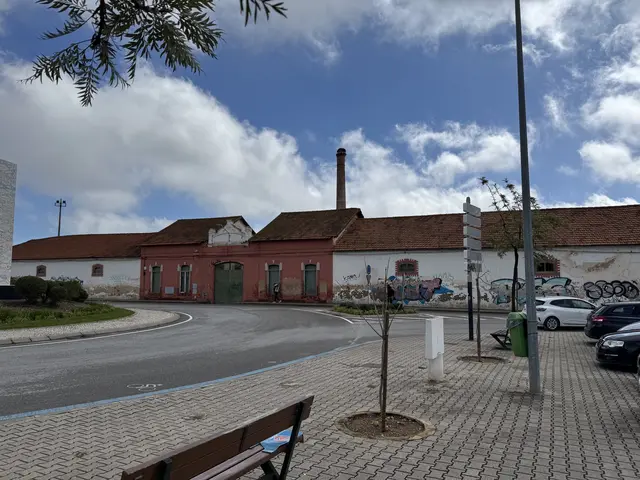
The cannery from 1917, the largest in town, closed in 1971; today a restaurant and nightclub.

Periods
Tags
Opening hours
Exterior only The building is not open to the public – the site is experienced from the outside.
Introduction
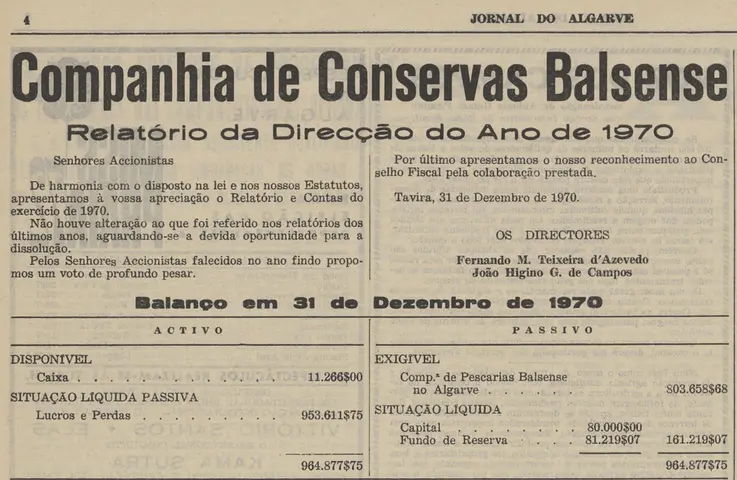
The long, low, whitewashed building by the roundabout on the way out of town is Tavira's old cannery. Companhia de Conservas Balsense opened here on 9 May 1917, on a plot that had partly been the town's rubbish dump, and was from the start the largest in town, with room for 30,240 cases. It inherited its name from the tuna fishing company whose shareholders paid for it. In 1971 it closed with a state subsidy made for exactly that. Since 2008 there have been concerts in the hall, and today it holds a nightclub and bars. The sister factory Tavirense stood directly opposite on the other bank. This is what is left of Tavira's industrialisation, and it did not last long.
Historical highlights
The town that wanted a factory
In November 1911 Mayor António Padinha put the canning industry among the town's priorities. The problem was concrete. Tavira's tuna was landed in Vila Real de Santo António. In 1915 a seaman sighed to a journalist from A Capital that the town would regain its strength if only a single cannery stood here. In August the same year O Povo do Algarve reported that the shareholders of the tuna fishing company Companhia de Pescarias Balsense had subscribed 50,000 escudos for a factory. Padinha died in November 1916 and did not see it open.
Four factories in two years
Balsense was inaugurated on 9 May 1917, and Tavirense followed in June on the opposite bank, with only the river between them. With the two small ones from 1915, Tavira now had four. According to Vieira Rodrigues the two large ones had 185 workers in 1917, and Balsense could pack 30,240 cases. The brands were called Balsa, Dom Paio Peres Correia, Paisagem and Whilk. The tuna came from the company's own armações, Livramento and Abóbora, supplied from shore at the factory. Carlos Faísca has shown that the municipality's industrial population in 1930 was at the Algarve average.
Tuna for Italy
Storms destroyed the town's four tuna arraiais in 1931, 1941, 1952 and 1962. In 1955 the board wrote that exports had become difficult and that Italy was the only market for canned tuna, with a single importer. In 1971 Balsense closed with a state subsidy meant to encourage the closure of struggling canneries; the year after, Arraial Ferreira Neto closed, having had the factory as a major customer. The figures are Carlos Faísca's, and his bigger picture belongs with them: in 1917 the Algarve had 184 canneries with 14,500 employees, half the country's; in 1987 the share was 15 percent.
Concerts, nightclub, sushi
In July 2008 Rosa Passos sang here, the first concert the newspapers mention. In 2017 the nightclub ECHO opened, in 2018 the sushi restaurant Daiya, and in August 2026 the lounge bar GUÄVA, whose owners, according to Postal do Algarve, want to give the place new life, not recreate the past. The building is neither listed nor registered. A bar in a factory hall is not preservation, but the hall is standing, and very few are.
Practical
The municipality calls the place Rotunda da Balsense; people in town say the BP roundabout. The building is best seen from the river side, with the old Tavirense on the other bank. You get inside in the evening, through the nightclub and the bars. Right next to it stood the tide mill Moinho da Forca, which was already falling apart in 2008.
Timeline and context
Timeline
- 1911 António Padinha puts the canning industry on the list of the town's priorities.
- August 1915 The shareholders of Companhia de Pescarias Balsense subscribe 50,000 escudos for a factory.
- November 1915 The small Fábrica Gilão opens with 30 to 40 women; Santa Maria the same year.
- 9 May 1917 Balsense is inaugurated; Tavirense follows in June on the opposite bank.
- 1917 The two large factories have 185 workers; Balsense can pack 30,240 cases.
- 1941 Cyclone on 15 February; the factory's roof is said to have collapsed.
- 1943 The accounts show in-house can production and an electrical installation.
- 1955 Italy is the only market for canned tuna, with a single importer.
- 1971 The factory closes with a state subsidy for closing struggling canneries.
- 2008 Rosa Passos concert in the hall.
- 2011 Part of the roof is said to have collapsed after a storm.
- 2017-18 The nightclub ECHO and the restaurant Daiya open.
- 2026 The lounge bar GUÄVA opens in August.
Why it is here
A plot by Forte do Rato was given up in favour of land at the exit towards Vila Real de Santo António, on the right-hand side of the main road, by the river. Part of it was the town's rubbish dump, hardly the most expensive land in town, and the tuna fishery at Livramento and Abóbora could be supplied from shore right here. Tavirense followed the same logic on the other bank. The museum catalogue calls the period a late and brief industrialisation, 1884 to 1917: salt pans, mill, railway and two tuna factories.
What is left
The long white building with its tiled roof and small windows, as in the catalogue's photo from 2008. No listing. Jorge Queiroz writes in the catalogue that the two factory buildings are still visible as traces of the 20th-century fishing industry, and traces is the right word. Tavirense is to become a hotel, Balsense is a nightclub. That is a more honest fate than a museum would be. The factory was built to make money, and it still does.