Flour, Bread and Machines — Industrial Tavira
Tavira is a city of churches — yet for eighty-five years two factories milled the town's flour behind a convent wall and a riverside façade. A short walk across both bridges, to the little mill that became a hotel and the great one that became apartments: the story of why Tavira never became an industrial town, and what the few factories left behind. Adapted by Flemming Berthelsen, based on research by Carlos Manuel Faísca.
Per ora questo racconto è disponibile solo in inglese.
Capitolo 1
The City That Almost Never Industrialised
Church towers, convent façades, azulejos. Tavira is so rich in religious and aristocratic architecture that the wealth has overshadowed another kind of heritage. That of factories, markets, the railway and workers' housing. This walk seeks out the other Tavira, the city that never became an industrial town, and the few factories that came anyway.
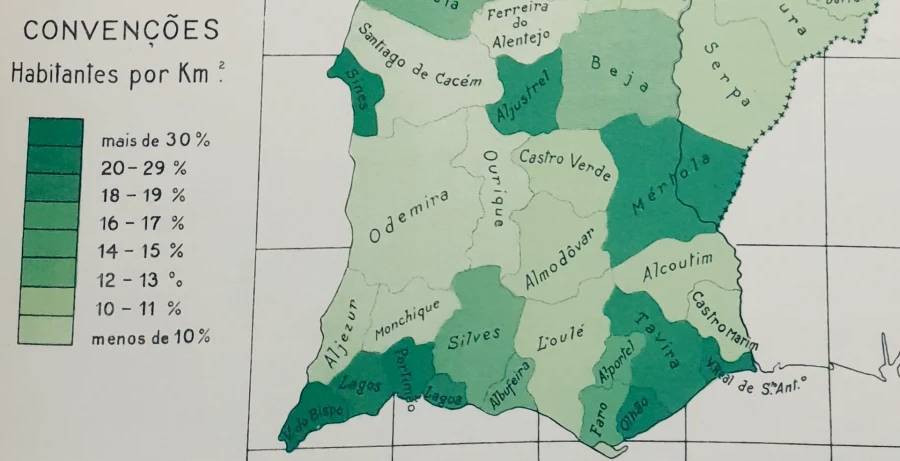
Portugal industrialised late and slowly. Its first industrial centres grew where the raw materials or the customers were, like the wool town of Covilhã, the cork town of Silves and the metropolitan areas of Lisbon and Porto. Tavira was none of these. Yet the city was not without industry. Four fish-canning factories, an ice factory, a paprika mill, sawmills, a smithy, a mechanical workshop and a printing house left their mark on the streets, and in 1930 the industrial population of the municipality sat right at the Algarve average. Neither ahead nor behind.
The engine of this story is something as down-to-earth as grain. The Algarve has never been able to feed itself. As early as the 1820s the customs house recorded imports of wheat and maize, and throughout the nineteenth century Tavira bought grain from the Alentejo. The purchases of 1849 and 1903 still stand in the records. In the fields, wheat dominated until the mid-twentieth century, when maize took over with the new irrigated crops. Rye all but vanished as the mountain parish of Cachopo, where it was grown, lost its people. The harvest never sufficed. Grain had to be brought in from outside, above all from the Baixo Alentejo, and milled here.
Two factories took on that task. A small one on the riverbank a few hundred metres from here, and a large one in a decommissioned convent at the other end of town. This walk visits them both and crosses the river twice, out across the old bridge and home across the new one.
Capitolo 2
The Bridge, the Street and the Little Mill
The Ponte Romana is the seam of this story. This is where the grain entered the city, and where you now cross to the left bank of the Gilão.
The street that opens at the end of the bridge has a story of its own. It was called Rua Borda d'Água de Aguiar, "the water's edge street", until the Republic renamed it Rua Jacques Pessoa on 7 November 1910. So it remained for 75 years. Between the end of 1985 and the start of 1987, the stretch beyond Largo da Caracolinha took back its old name. When the sources in this chapter say Rua Jacques Pessoa, they mean today's Rua Borda d'Água de Aguiar.
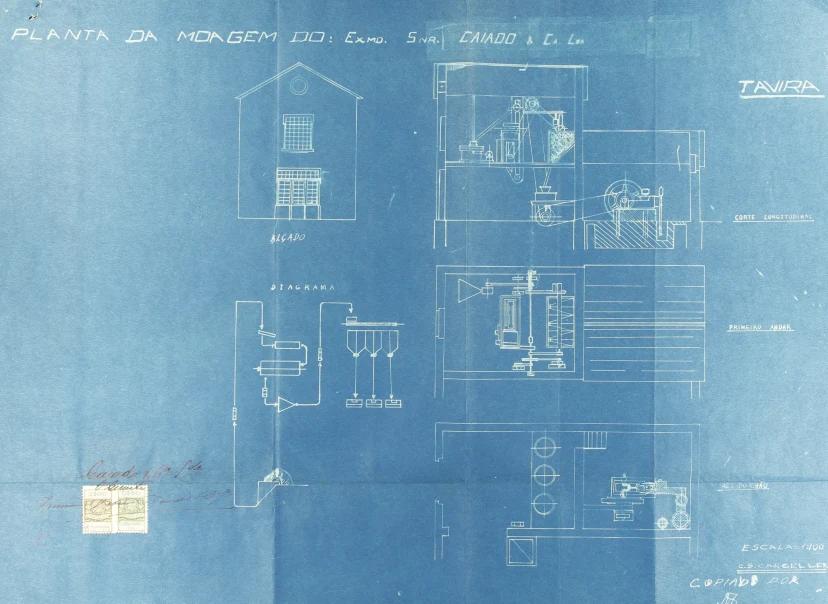
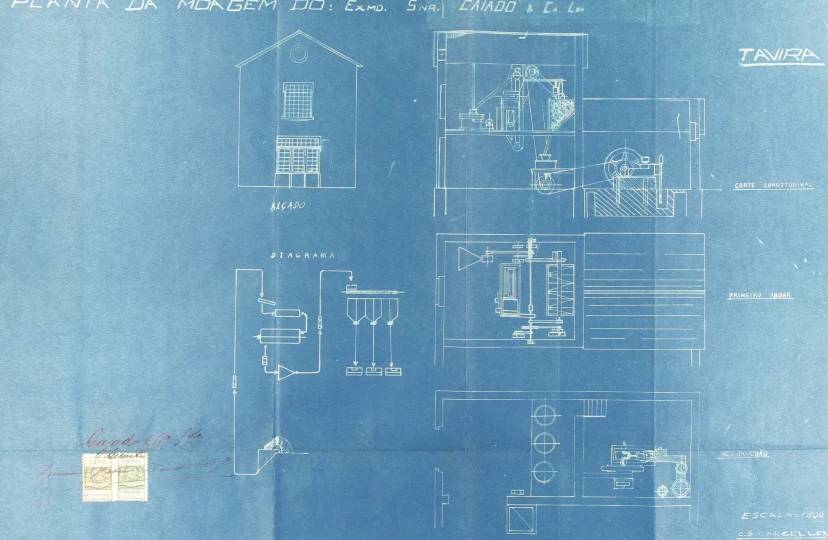
A few steps down that street, at number 34, stood the little mill. On 15 July 1935 the firm Caiado & C.ª applied for a licence to mill flour here. They were cork people, who also ran a small factory in Faro making stoppers and cork boards for Germany. The licence had originally been granted to the firm's mill in Sabóia, in Odemira, but the ministry allowed the transfer. What settled the case was the size of the Tavira market, not least the densely populated Serra de Tavira, then considered an important grain-producing hinterland.
The equipment was modest and deliberately old-fashioned. Two pairs of millstones, the same technology as in windmills and watermills, grain cleaners and a "National" engine of 35 horsepower. Five employees at the start, soon seven, and the mill running by about 1936. It produced farinha em rama, the coarser stone-ground flour for the cheaper country bread. The white flour for town bread came from the big competitor on the other bank.
In 1939 Caiado & C.ª sold everything to Araújo Ribeiro & Dias, Lda. In 1942 the new owners bought a maize and rye mill that had worked in Lagos and moved the machinery here. The authorities approved it because the municipality's own maize and rye were poorly used. The law required the maize milling to be physically separate from the wheat, so it became two buildings and one firm. At its peak the mill employed 14 men. The millstones could grind seven tonnes of grain in an eight-hour shift, the hammer mills 15 tonnes, and cattle feed was mixed from barley and carob. Bread ovens and a metal workshop followed.
The owners changed again, in 1951 and 1959, and the mill kept grinding, even after the big competitor closed in 1968. Only in 1975 did the machines stop. In July that year the licence file was closed with a note that all the machinery had been sold to a man in Portimão. In 1986 the main building opened as the guesthouse Princesa do Gilão, today a hotel of the same name, and in 2014 the warehouse next door was demolished for a car park. You will pass the building shortly, on the way to the new bridge.
Capitolo 3
What a City Remembers
You are back on the right bank, in front of the old market hall by the river. Stop here a moment, not for the building alone, but for the category. Markets, railway, factories, workers' housing. The heritage of everyday life.
Tavira's wealth of churches, convents and palaces, most of it listed as a national monument or building of public interest, has a downside. It has drawn attention away from everything else. That is the historian Carlos Faísca's point, and this is where it lands. What a city remembers is no accident. The mill you have just seen became a hotel in 1986. The hotel's own history mentions the factory, but inside the building the reference is modest. The international council for industrial heritage, TICCIH, recommends exactly this kind of reuse of industrial buildings, as long as the old activity is still told. Reuse saves the walls. Memory needs someone to carry it.
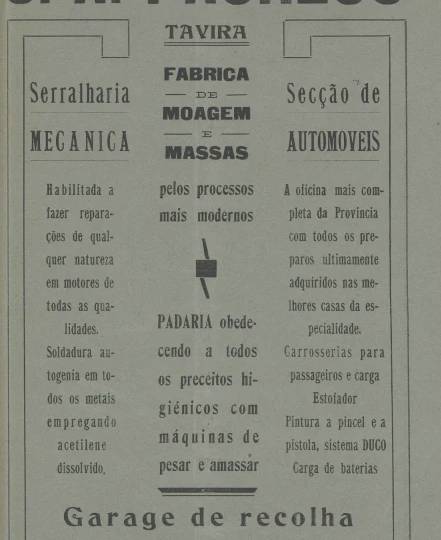
How much city there was in industrial Tavira can be seen in an advertisement in the local newspaper O Povo Algarvio. J.A. Pacheco, the man who owned the great mill we are heading for, advertised a mechanical workshop, a flour and pasta factory, a bakery, a motor department and a garage at Bela Fria with room for 100 vehicles, "the most spacious in the province". All of it in Tavira, all of it in the language of the 1930s. The firm's businesses employed around 80 people in this town alone.
The market hall here is itself an example of the category, and proof that reuse works. It survived because the town found a new use for it. Now follow the riverbank south-east, towards the convent and the great mill.
Capitolo 4
The Great Mill in the Convent
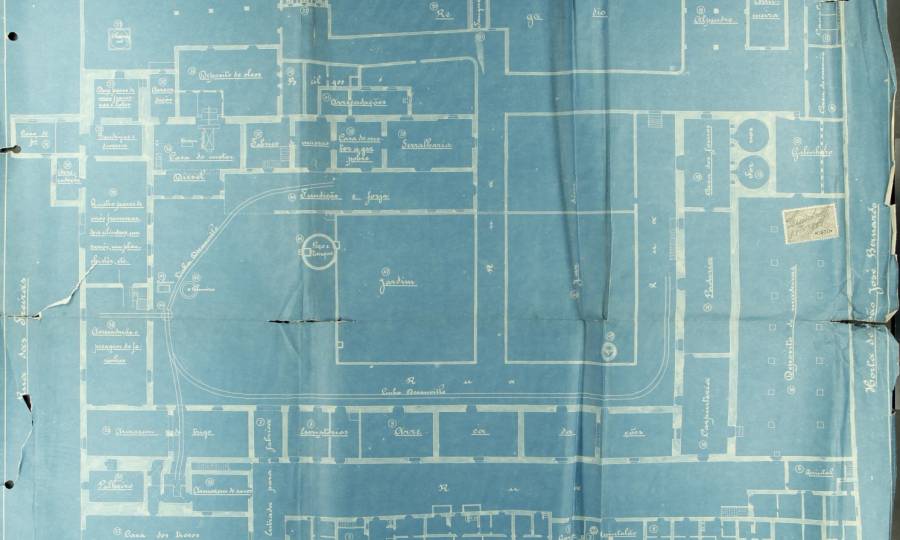
The convent in front of you housed the most modern flour factory in the Algarve for 78 years. The nuns left Nossa Senhora da Piedade, the Bernardas convent, in 1862, after the religious orders had been abolished, and the building stood empty for decades. Then, on 17 December 1890, a local businessman named João Daniel Gil Pessoa offered the town council a fixed annual contract of 200 mil réis to supply "all the products of his industry" from the disused convent. It is the factory's oldest documentary trace, and the name is worth pausing on. João Pessoa was a grandson of the poet Fernando Pessoa's great-grandfather.
His venture was short. In March 1891 the factory burned, and that same summer a new company took over the ruins, the Companhia Tavirense de Moagens e Massas a Vapor, "the Tavira steam milling and pasta company". The capital was local, 480 shares spread around the town, and among the company's people were the town's leading figures, including a future mayor and the town's printer. In 1900 a single steam engine drove seven pairs of millstones. By 1903 there were two steam engines with a combined 125 horsepower and 22 workers. More important still, alongside the millstones ran roller mills on the Austro-Hungarian system, steel cylinders that grind the grain gradually, pass after pass, into white sifted flour, farinha espoada. The Bernardas was the pioneer in the Algarve. The little mill on the other bank never touched that technology.
The company was too big for its market. In 1920 everything was sold for 89 contos to Joaquim António Pacheco of Olhão, and under his name the complex grew. In 1928 it held three licences, flour, pasta and bakery, and 43 workers. In 1931 it bought another bakery in town. The factory made its own electricity with a generator and offered its workers its own medical care beyond what the law required.
It did not all run smoothly. In 1938 Pacheco wanted rid of the factory and leased it to a company from Almada, which planned to move the machinery and the wheat quota to its large mill near Lisbon. The authorities first said yes. Then suspicion arose that Pacheco had installed more mills than his licence allowed, and the deal collapsed. Pacheco reversed course and in 1940 brought machinery and quota from a mill in Ourique to Tavira instead. In 1953, 53 people worked in bread production, and ten roller mills transformed 128 to 136 tonnes of grain in every eight-hour shift.
Walk around to the façade on Rua dos Mártires da República. That was the gate the workers entered by, and their housing lay there. The chimney by the convent church belongs to the same works. The factory closed in 1968. Today the convent is housing, converted by the architect Eduardo Souto de Moura, and precisely the façade and the chimney were left standing as industry's mark.
Capitolo 5
The Unnecessary Mills
How big was the great mill, really? In 1901 the Companhia Tavirense had the capacity to grind 3,600 tonnes of wheat a year and actually ground 1,616. The largest mill in the country had capacity for 70,500. Seen from Lisbon, Tavira was a dot. Seen from the Algarve, the Bernardas was a giant, in 1936 the province's second-largest mill, and in 1957 still second in the Algarve and eighth in all of Portugal south of the Tagus.
That 1936 figure comes from a document whose name says everything about the industry's fate, the list drawn up by the "Commission for the Classification of Mills Considered Unnecessary", the Comissão de Classificação das Moagens Consideradas Desnecessárias. Portugal had built too many mills, and the state was preparing to single out the ones it could do without. The same list includes the little mill on the other bank, Caiado & C.ª, with more capacity than three other Algarve mills, one of them in Cacela, only 12 kilometres from here. Neither of Tavira's mills was struck off. The end came all the same. In 1968 the Bernardas closed, in 1970 the licence was cancelled, and the machinery for fine flour ended up in Faro. The little mill, paradoxically, held out longest, until 1975. Eighty-five years of flour in Tavira were over.
The mills were not alone. Four fish-canning factories worked in the town in the same period, the Balsense, A Tavirense, José Matos Parreira's and the Calça brothers', and J.A. Pacheco himself ran a cannery in Olhão alongside the flour. Fish, salt and grain were industrial Tavira.
In the early 1950s the town's two mills gave work to nearly 70 people. Today one is a hotel and the other is housing, and the most visible thing industry was allowed to keep is a chimney by a convent church. But now you know what to look for. The city that almost never industrialised, and has almost forgotten that it did.
Fonti
- FAÍSCA, Carlos Manuel, «Indústria e património industrial moageiro na cidade de Tavira, 1890–1975», FOLIUM – Revista do Arquivo Municipal de Tavira, n.º 1 (2024), pp. 30–45
- Câmara Municipal de Tavira, FOLIUM – Revista do Arquivo Municipal de Tavira, n.º 1 (2024)
- TICCIH, Carta de Nizhny Tagil sobre o Património Industrial, 2003
- SIPA/DGPC: Convento das Bernardas (IPA.00015692), Ponte Antiga sobre o Rio Gilão (IPA.00001294), Mercado Municipal de Tavira / Mercado 30 de Junho (IPA.00010087), Núcleo urbano da cidade de Tavira (IPA.00010025)
- SANTANA, Daniel, «A história atravessa o rio: a ponte antiga de Tavira (e outras travessias)», in APPLETON, Júlio (coord.), As Travessias do Rio Gilão em Tavira, 2021
- Hotel Princesa do Gilão, «Sobre nós»
- Turismo de Tavira, Percursos – Aquém da Ponte
- ArchDaily, «Convento das Bernardas / Eduardo Souto de Moura» (2015)
- Adapted by Flemming Berthelsen, based on research by Carlos Manuel Faísca
- Images reproduced with the permission of Carlos Manuel Faísca; each caption credits the original institution and archival reference
Ultima revisione: 4 settembre 2026