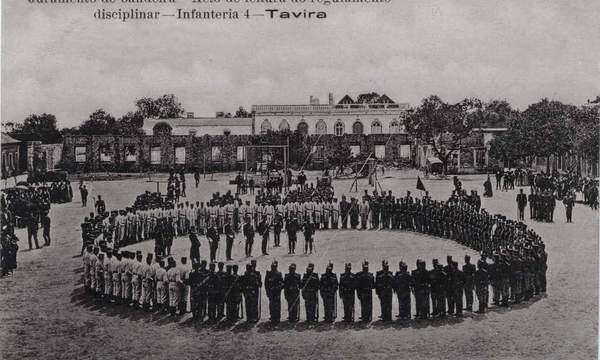
©Postal J. Vianna (Lisboa) n.º 4989 «Juramento de bandeira – Infanteria 4», c. 1909 · Col. A. Monge da Silva · Aveiro e Cultura – Arquivo Digital (1909)
Quartel da Atalaia
Introduction
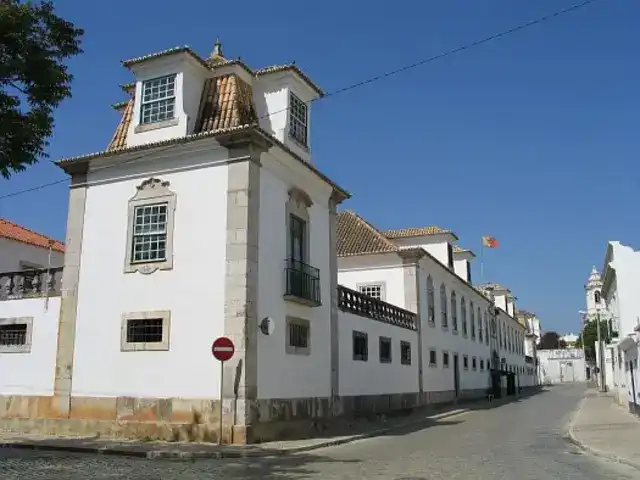
A long facade of seven bays, a gate with a military coat of arms above it, and at each corner facing north a slender tower with a mansard roof. The plaque above the gate says that Queen Maria I had the barracks built in 1795 for the regiment that was to hold the town. The listing text calls it one of the country's oldest barracks, and it is still military, so you cannot go in. The surprising thing is how long it took to come into being. Construction stalled shortly after 1795, the half-finished building was a cholera hospital in 1833, work resumed in 1856, and only around 1900 did the soldiers move in.
Historical highlights
The governor's barracks
Around 1780 the Algarve's infantry regiment was moved from Faro to Tavira, and the governor, the conde de Val de Reis, pressed the court for barracks that could house it decently. The inscription above the gate gives him the credit: built in 1795 under Maria I, at his urging and under his direction. Who drew the plans, nobody knows. SIPA says unknown; the municipality points to the engineer colonel José de Sande Vasconcelos, who had worked on Vila Real de Santo António and in 1795, on the governor's orders, drew a military hospital for Tavira. It is a good guess, no more.
A hundred years to finish
According to the municipality, work stopped shortly after 1795 and was only taken up again in 1856. In between lay the French invasions, the court's flight to Brazil, the introduction of liberalism and the civil war. Meanwhile the soldiers lodged privately in the town and, from 1835, in the dissolved Convento de Nossa Senhora da Graça. The unfinished building was put to use anyway: during the cholera epidemic of 1833 it was a hospital for the town's civilian sick. It was only finished in the first years of the 1900s, and only then did Tavira's garrison move in. So the year above the gate is a little misleading. 1795 is the year they began.
Regiments, light infantry and sergeants
The town's units changed name more often than the building changed shape. Regimento de Infantaria 14 was disbanded around 1837 after having backed D. Miguel in the civil war. Then came the light infantry battalions Caçadores 5 and 4; the latter sent men to Mousinho de Albuquerque's columns in 1895, and according to Povo Algarvio (1960) King Carlos said in 1897 that it was an honour to stand in a barracks with so many brave men from Africa. From 1939 the barracks trained conscript sergeants, from 1948 as the unit CISMI, until 1975. In 2008 Regimento de Infantaria 1 moved in, and in 2015 moved on to Beja. Around 50 men stayed behind.
Practical
The barracks are still in use and come under the ministry of defence, so you see them from outside, from Rua Poeta Isidoro Pires and Rua 9 de Abril. Look for the gate with the coat of arms, the elliptical window and the inscription plaque above it, and for the two corner towers with mansard roofs facing north. At the back of the building are an iron gate and a round sentry box. The gates open now and then for exhibitions; in 2024 the municipality and the regiment showed Alfredo Cunha's photographs from 25 April 1974 in here, free, Tuesday to Saturday for seven months.
Timeline and context
Timeline
- 1755 The earthquake; the governor of the Algarve moves from Lagos to Tavira.
- c. 1780 The infantry regiment is moved from Faro to Tavira.
- 1795 Maria I has the barracks built at the governor's urging; work soon stalls.
- 1833 The unfinished building is a cholera hospital for civilians.
- c. 1837 Regimento de Infantaria 14 is disbanded; Caçadores 5 takes over.
- 1856 Construction resumes.
- 1897 King Carlos visits the unit, according to a recollection from 1960.
- c. 1900 The barracks are finished and the garrison moves in.
- 1917 A battalion of Regimento de Infantaria 4 is sent to France.
- 1939-1975 Sergeant courses, from 1948 as the unit CISMI.
- 2008 Regimento de Infantaria 1 moves in and refurbishes.
- 2012 Listed, with a protection zone.
- 2015 RI 1 is moved to Beja; a detachment stays.
The name is older than the barracks
Atalaia means lookout post. The squares Largo da Atalainha and Largo da Atalaia existed before the barracks; Sande Vasconcelos drew a plan of the first one for the governor around 1790-95. What the lookout was for, none of the sources consulted say. The site was the old Quinta da Atalaia, fields and gardens on the edge of town, and the barracks belong to the expansion of Tavira that followed after the governor moved here from Lagos after 1755. When the army had the site archaeologically monitored in 2008, nothing was found.
Still a barracks
The unusual thing about Quartel da Atalaia is that it is still used for what it was built for. The army's 2014 reform plan would have closed it, but the plan was cancelled after the change of government in 2015, and the detachment stayed. An opinion piece in Postal do Algarve in 2021 mentioned that in 2008 there had been talk of a hotel, a university and a shopping centre, and proposed a school for firefighters. For now it is a barracks with around 50 men and a gate that opens for an exhibition now and then.