Jewish Tavira — A Hidden History
For centuries a Jewish community of doctors, goldsmiths, merchants and notaries helped shape Tavira — until the royal edict of 1496 forced everyone to convert or leave. This story follows their traces through four places in the old town: the square where their history is on display today, the walled town that held the medieval judiaria, the convent built over the likely site of their synagogue, and the river that carried the persecuted towards new lives abroad. On the map you will also find the field west of the old town where their burial ground is thought to have lain.
Chapter 1
A Community by the River
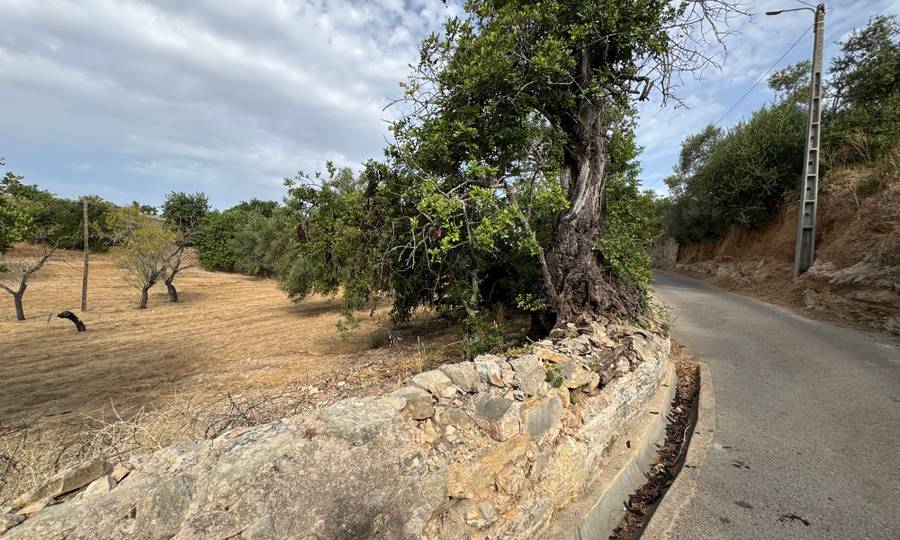
A Jewish community is documented in Tavira from the 13th century onwards. Doctors, goldsmiths, merchants and notaries who helped drive the economic and cultural life of a busy port town. They were no marginal group. In 1370 the Jews of Tavira complained directly to the Crown about being forced to stand watch duty on the town walls, and you do not petition the king unless you know you have rights.
Then, within a single generation around 1500, that world was legislated out of existence. Afterwards it vanished twice, first the people, then even the memory of them. Their quarter was built over, their burial ground ploughed into farmland. For five hundred years the story survived only in fragments, as names in trial records, a field with a curious name and a handful of small objects in the ground.
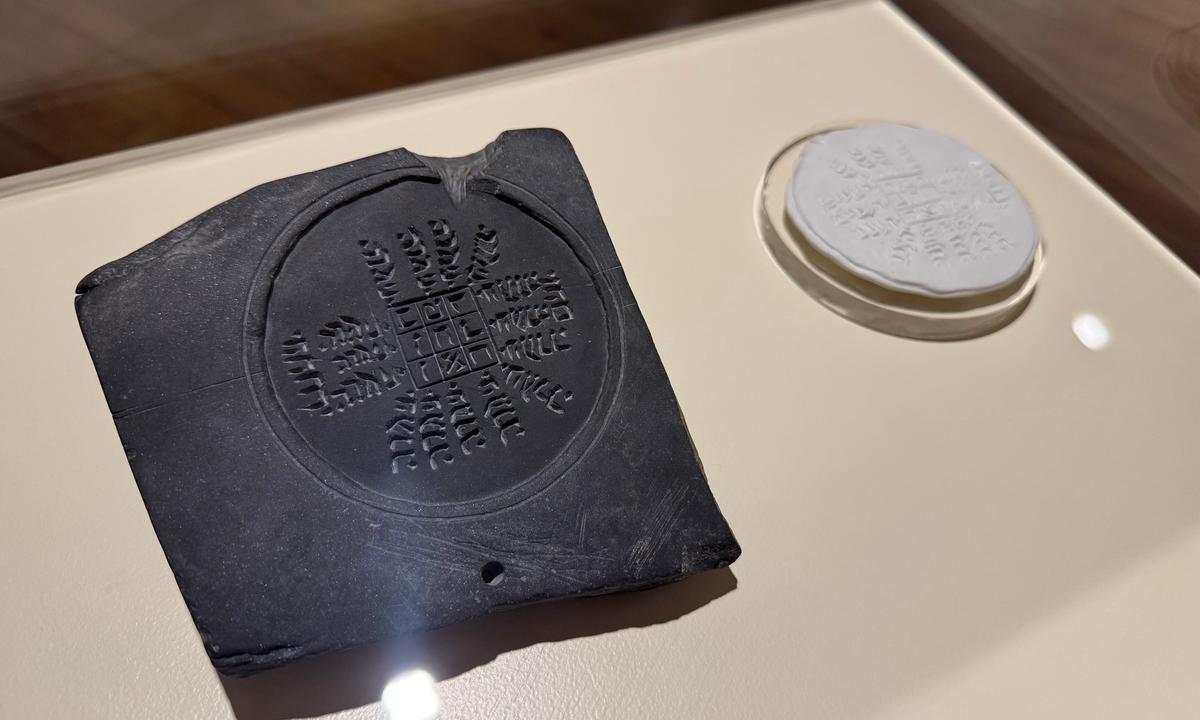
The recovery of those fragments begins here. In the Núcleo Islâmico, the small museum on this square, the exhibition "Judeus em Tavira: Fragmentos de uma História" (on show until the end of 2026) gathers them for the first time. A slate mould for casting kamea protective amulets, a keyhole plate shaped like a hamsa hand, and oil lamps lit at Hanukkah.
The story of the mould begins with an accidental find. In 1979 a landowner was digging foundations in Tavira's hinterland, at a spot the researcher José Fernandes Mascarenhas (1909-2005) recorded as the sítio de Pero Gil, known as the Adro do Judeu, the "Jew's Yard" in the singular. He turned up objects bearing Hebrew inscriptions and entrusted them to Mascarenhas, who announced the find in the press, published the first study of the pieces and deposited them in the parish museum of Moncarapacho. Mascarenhas himself stressed that the spot must not be confused with the burial ground. By all the evidence a single Jew lived out here, beyond the quarter, and the objects hint at who he was. The most recent research reads them as the traces of a rabbi versed in Kabbalah, the mystical tradition of Judaism, and dates the find to between the late 13th and mid-14th century.
Look closely at the mould. At its centre sits a magic square in which the numbers, written as Hebrew letters, always add up to fifteen, a number that spells part of God's name, Yah. Around it, repeated fifteen times, runs the plea "YAH ANANI", O God, answer me, from Psalm 118. Amulets cast from this stone were meant to ease difficult childbirths, protect newborns and heal the sick. Five hundred years on, the fears and hopes of Tavira's Jewish families are still legible.
The town also had its burial ground. Jewish communities buried their dead outside the walls, and the museum's exhibition places Tavira's in the fields west of the old town, where the route map shows it. How certain that location is, you will hear at the convent. This walk stays in town and visits the other places the fragments came from, all within a few hundred metres of this square.
Chapter 2
Inside the Walls
![Spanish military map of Tavira, c. 1650, copied from a Portuguese survey of the mid-1500s: half a century after the forced baptisms, the quarter was still marked by name — “27. Judiaria” — north-east of the church of Santiago. Planta de la ciudad de Tavilla, Leonardo de Ferrari [c. 1650–1655]. Krigsarkivet/Riksarkivet, SE/KrA/0414/0025/0011.](https://rrkivosxnrfvdawawexd.supabase.co/storage/v1/render/image/public/images/img-tavira/original/jewish-ferrari-c1650-judiaria-27.jpg?width=900&height=540&resize=cover&quality=70)
Medieval Tavira was a walled town, and its judiaria, the Jewish quarter, lay inside those walls, just in front of the old Porta da Afeição gate. This was no informal neighbourhood. Royal charters under kings Pedro I and Fernando in the 14th century confirmed the quarter's status and its inhabitants' rights. Jewish Tavira was organised, recognised and royally protected.
But why did the kings protect? The answer lies in a dispute over wine. Wine made by Jews, vinho judengo, was one of the quarter's most important trades, and in 1381 Tavira's town council banned its sale outside the judiaria, invoking a municipal by-law of 1362 that set the penalty at thirty days in jail and a fine of a hundred libras. The community appealed to the Crown, presenting its royal charters from Pedro and Fernando. King Fernando's answer survives. The Jews were to be guarded "come cousa de nosso tesouro", as a thing of our treasury, for the Crown drew great taxes from that very wine. In the eyes of the law the Jews were povo do rei, the king's people, and their protection was not idealism but fiscal self-interest.
That protection did not always hold in the street. On 7 January 1434 King Duarte had to write to Tavira's judges and officials because Jewish craftsmen were being forced to work without pay under threat of beatings, and the abuse was driving families into exile in North Africa, where Jewish communities already existed. When the Crown pardoned Joce Garção, a Jew of Tavira's commune, in 1440, it did so with the explicit justification of "repopulating depopulated places". So the emigration did not begin with the decree of 1496. It was under way more than sixty years earlier.
Even so, the quarter was also a place of learning. Around 1440 the physician-surgeon Mestre Salomão de Tavira trained disciples who travelled here from Beja and Serpa to study medicine. A generation later a doctor known as Mestre António, formerly the rabbi of Tavira, rose to become chief surgeon to King João II. When he was baptised in 1486, the king himself stood as his godfather.
Hold on to that image. A community of doctors and scholars whose most gifted son had the king for a godfather. Barely ten years after that baptism, the same Crown would order every Jew in Portugal to convert or leave. From these ramparts you overlook the rooftops under which both halves of that story played out.
Chapter 3
The Vanished Judiaria
In December 1496 King Manuel I gave every Jew in Portugal a choice that was no choice. Convert to Christianity or leave the kingdom. The following year brought forced mass baptisms, and children under fourteen were taken from parents who refused. Tavira's Jewish community ceased to exist as a legal body, and its members were renamed cristãos-novos, "New Christians".
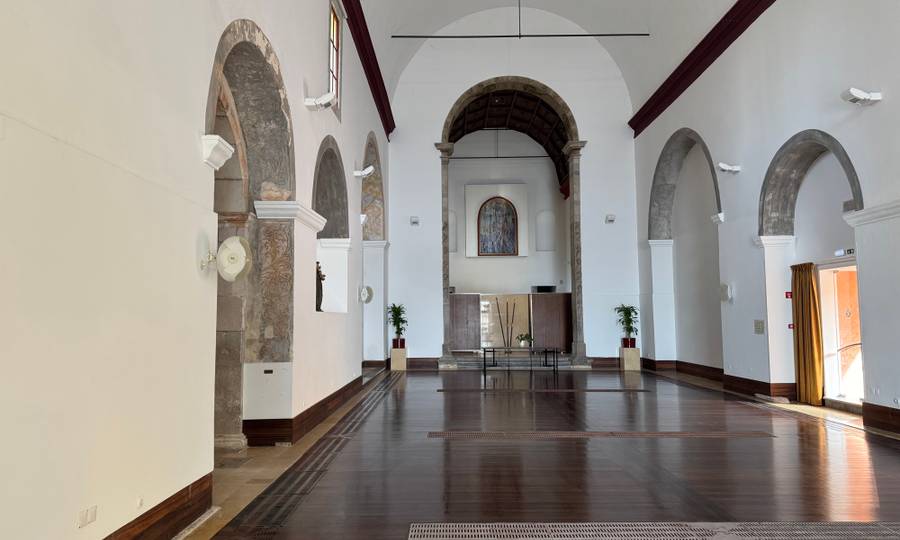
Then the town built over their quarter. The Augustinian convent of Nossa Senhora da Graça was founded here in 1542, on the ground of the old judiaria. Tavira's own historical guides say so plainly. An early chronicle goes further, recording that the friars "made a church of the synagogue", and one analysis of a 16th-century plan of Tavira suggests the first convent church was indeed installed in the former synagogue building.
The friars found no safety here either. Frei Valentim da Luz, prior of the convent from 1558 to 1560, was condemned by the Inquisition in Lisbon and executed at the auto-da-fé of 10 May 1562. The charge was not Judaism but Lutheranism. He had criticised the cult of the saints and the authority of the pope, doubted purgatory and argued for Scripture in the vernacular. Twenty years after the convent was founded, the machinery that had dissolved Tavira's Jewish community reached the men who had taken over its ground as well, only now from the other side.
Archaeology tells a more careful story. The excavations carried out before the convent became a pousada could not confirm the synagogue itself. What they mainly revealed was an even older Almohad Muslim quarter beneath. But in 2002 they also brought up fragments of Hanukkah lamps, four according to the museum's exhibition, two according to the published excavation report, and their form and context confirm them as ritual objects of the medieval Jewish community. Islamic quarter, judiaria, convent, hotel. This single patch of ground holds the whole layered history of Tavira.
And then the burial ground. It lay outside the walls, but the sources disagree about where. The museum's exhibition points to the fields out along the road to the west, some 450 metres from here and marked on the route map. There is nothing to see but farmland, and you return the same way you came, so make the detour only if you want to stand on the ground itself. The historian Miguel Ângelo Pereira instead follows an older record of place names, according to which it was the Largo do Cano on the old road to Faro that was called Adro dos Judeus until the Jews disappeared from the town.
Chapter 4
Flight and Memory
Conversion did not end the story. It drove it underground and down to the river. In the trial records of the Inquisition, Tavira's New Christians appear clustered along the waterfront. Rua Nova and the riverside square are named again and again as the streets where they lived, close to the ships that carried their trade to Morocco, Castile and the Low Countries.
Behind closed doors, some kept the old faith alive in disguised forms. New Christians in the Algarve confessed to keeping the Sabbath "in the heart, not in deed", to laying out clean linen and fresh lamp wicks on Friday evenings, and to timing the fast of Yom Kippur by the farming year, "when the figs are stuffed" or "at grape time". Some even offered the Our Father to Moses.
And on 22 October 1525 a ship put in here carrying David Reubeni, who presented himself as the envoy of a lost Jewish kingdom in the East. New Christian families in Tavira welcomed him and kissed his hand, and many dared to hope that deliverance had come. The letter he wrote from this town to King João III still survives in the national archives, and his own diary tells more about his days here. In the house of a respected New Christian where he lodged, he met a man still known as Rabbi Salomão. A rabbi in Tavira in 1525, three decades after Judaism had been outlawed in Portugal. When a Spanish monk, in a theological dispute, denied that Israel could have a king, Reubeni by his own account seized him and threw him out of a large window in front of everyone, and when the town's chief magistrate, himself a New Christian, heard of it, he "rejoiced greatly". Soon afterwards Reubeni had a Muslim woman he had bought as a slave converted to Judaism by public tevilah, ritual immersion, in the river Gilão, the very water this bridge spans. The authorities did not step in.
Should all of this be taken literally? Historians hesitate. A monk thrown from a window without legal consequences sounds like an embellishment, told to lend Reubeni the glow of a fearless leader. Yet even as boasting the scenes are revealing. They presuppose a town on the kingdom's edge where the line between the forbidden and the tolerated was still being negotiated.
What came instead was the Inquisition. The first trial of a Tavira New Christian was opened in 1545, against the eighty-year-old João Lopes, and from 1558 the town became the main target of the Inquisition's first campaign in the Algarve. The blow fell in the 1560s. On 28 June 1563 at least fourteen New Christians from Tavira were locked in the prisons of Lisbon, and an arrest warrant of 19 April 1564 named nineteen more. Some had already fled, to Cape Verde, even to Peru. The merchant Gaspar Fernandes was handed to the secular arm at the auto-da-fé of 11 June 1564. Others reached Morocco and the Low Countries and carried Tavira with them into the Sephardic diaspora. What remains today are the fragments this story has followed. Names in the archives, a field with a name, and a handful of small objects in a museum by the square where you began.
Sources
- Miguel Ângelo Pereira, «Os Judeus Tavirenses no Medievo: um caso de estudo», FOLIUM – Revista do Arquivo Municipal de Tavira, n.º 3, 2026
- Frei João de São José, Corografia do Reino do Algarve (1577), ed. Rui Manuel Loureiro & Daniela Nunes Pereira
- Carla da Costa Vieira, Uma amarra ao mar e outra à terra. Cristãos-novos no Algarve (1558-1650), tese de doutoramento, FCSH/UNL, 2013
- Carla da Costa Vieira, «Eu não sou eu nem o outro». Cristãos-novos no Algarve. A construção de uma identidade?, FCSH/UNL
- José Alberto Tavim, «David Reuveni, un “ambassadeur” inhabituel (1525-1526)», Éditions Chandeigne
- Arquivo Nacional da Torre do Tombo, Cronologia do Tribunal do Santo Ofício e da Inquisição em Portugal
- SIPA/DGPC: Igreja e Convento de Nossa Senhora da Graça, Tavira (IPA.00015693)
- Câmara Municipal de Tavira, Guia Histórico de Tavira
- Museu Municipal de Tavira, exposição «Judeus em Tavira: Fragmentos de uma História», Núcleo Islâmico, 2026
- José Pedro Paiva, «D. Jerónimo Osório, bispo do Algarve, e a Inquisição», Universidade de Coimbra
- Research and text: Flemming Berthelsen, following a visit to the exhibition in July 2026. Compiled with AI-assisted research and checked against the sources listed above.
Last revised September 4, 2026