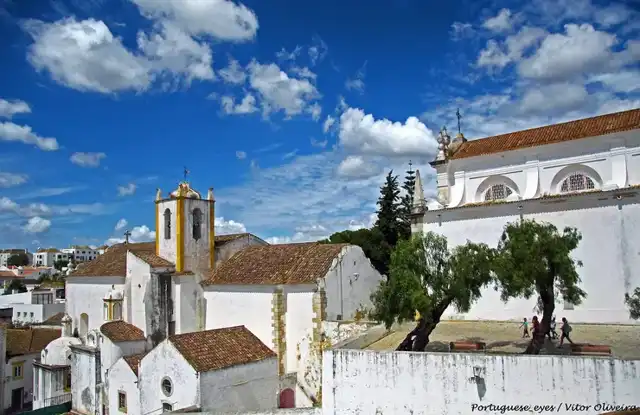
©Vitor Oliveira from Torres Vedras, PORTUGAL, CC BY-SA 2.0 <https://creativecommons.org/licenses/by-sa/2.0>, via Wikimedia Commons (2017)
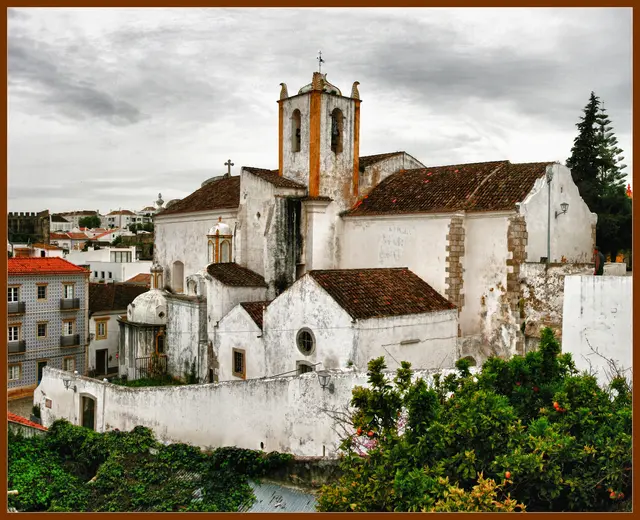
©Bert Kaufmann (2012)
Igreja de Santiago
Introduction
Above the door rides Santiago with raised sword, an 18th-century stucco medallion. It is the one showy thing about a church that is otherwise as plain as a lack of money can make it. It stands a few steps below Santa Maria do Castelo, inside the castle wall, and was the parish church of the parish of Santiago from the 13th century. The earthquake of 1755 broke it apart, and the rebuilding dragged on so long that in 1763 the king let the brotherhoods' income go to the construction. Inside hang retables and paintings, brought in from churches in the town that have since closed, and an organ from the same century. The eastern Portuguese pilgrim route to Santiago also starts here.
Historical highlights
Mosque or not
Tradition in Tavira says that Santiago stands on top of the town's "mesquita menor", the smaller mosque, while Santa Maria up on the hill got the large one. The municipality goes no further than to say that the church "very probably" reused a building from the Muslim period. No one has dug, and nothing has been found. Sandra Cavaco, who has written about Islamic Tavira, doubts that the town had two mosques; perhaps there was a zāwiya here, a small house of prayer. What is certain is that the church was built in the second half of the 13th century with a single nave and a rectangular chancel, and that Afonso III gave it to the bishop of Silves, D. Bartolomeu, in 1270.
When the king had to pay
Vasconcelos writes that the first church collapsed, perhaps in an earthquake, long before 1755; that cannot be verified. The quake of 1755 is well documented. It hit the church hard, the parish had no money, and the rebuilding dragged on for years, until D. José I decided in 1763 that the income of the brotherhoods based in the church should go to the construction. The result is the church you see: a single nave, a rectangular chancel, two chapels and a bell tower on the north side, each with a small dome and a blind lantern. The municipality's church guide calls the architecture "very plain" and puts it down to lack of money.
Outside and inside
The medallion above the portal is from the 18th century: Santiago as a warrior on horseback, "Santiago mata-mouros", the Moor-slayer, after the legend that he appeared at a battle during the Reconquest. That the battle was at Tavira is something none of the municipality's sources say. Inside there are eight decorated chapels, carved retables and paintings, some brought from churches in the town that have since closed, and the Painéis de Tavira from the 15th and 16th centuries. The organ is attributed to Joaquim António Peres Fontanes of Lisbon, 18th century, and was restored in 2000. The church is not a listed building, which is odd with contents like these.
Practical
The church is on Rua D. Paio Peres Correia, just below Santa Maria do Castelo, so take the two together. The association Artgilão, which receives visitors, gave the 2024 opening hours as weekdays 10:00 to 13:00 and 14:00 to 17:00, admission 4 euros or a "passport" to three or five of the town's churches (9 and 12 euros); check before you go. Look for the urns on the corners of the facade and the small domes on the chapels and tower, and walk round to the north side, where the church lies half buried in the slope. From here runs the Caminho Nascente, the eastern Portuguese pilgrim route, 663 km in 30 stages to Trancoso.
Timeline and context
Timeline
- Second half of the 13th century The church is built shortly after the conquest, by tradition on top of the smaller mosque.
- 1270 Afonso III gives the church to the bishop of Silves, D. Bartolomeu.
- Until the 15th century The parish of Santiago reaches all the way to Moncarapacho.
- Before 1755 According to Vasconcelos, the first church collapses, perhaps in an earthquake.
- 1755 The earthquake hits the church hard.
- 1763 D. José I lets the brotherhoods' income go to the rebuilding.
- Second half of the 18th century The present church is completed, with medallion and organ.
- 2000 The organ is restored by Dinarte Machado.
- 2001 The cross on the facade is replaced.
- 2013 The parish of Santiago is abolished as a freguesia and merged with Santa Maria.
- 2016 and 2025 The Museu Municipal holds "Passeios na História" in the church.
Church number two
Tavira got two parish churches inside the walls right after the conquest: Santa Maria at the top of the hill, where the mosque stood, and Santiago a few steps below. Tradition gives Santa Maria the large mosque and Santiago the smaller one, but no one has found a stone to prove it. The balance of power is more certain. The Order of Santiago held the patronage of Tavira's churches, but Afonso III gave this one to the bishop of Silves in 1270, and there it stayed. The parish reached all the way to Moncarapacho until the 15th century. In 2013 it was merged with Santa Maria, so the two old neighbouring parishes are now one.
A poor man's church with rich furnishings
What stands today is a church built by a parish without money. The municipality's guide says so itself: the architecture is very plain, and that is down to lack of money after 1755. No listing, no special status. It is still worth going in. Eight chapels with retables, paintings from churches in the town that no longer exist, the Painéis de Tavira from the 15th and 16th centuries and an 18th-century organ, restored in 2000. Above the door rides Santiago as a warrior; the municipality lets the legend stand as "a battle during the Reconquest" without tying it to Tavira, and that is wise.